Enhancing Blood Donation Efficiency in Sabah, Malaysia Through Human-Centred AI and Community Movement
By the OLITHLI Research and Statistics Team, supervised by INCOLORG
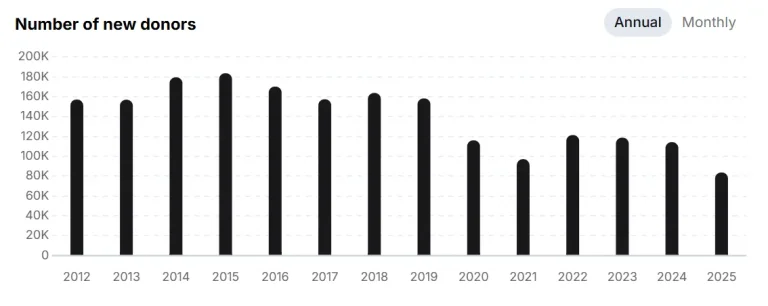
Data by KKM
Executive Summary
Blood is life. Every drop carries oxygen, strength, and hope. Yet, in Sabah, many lives hang in the balance, not because solutions do not exist, but because the supply of donated blood cannot keep up with the need. Behind every shortage is a story: a patient waiting, a family hoping, a doctor racing against time. This white paper presents a new approach that combines the intelligence of an in-house Large Language Model (LLM) with the heart of a people-driven movement. It is not just about improving systems. It is about awakening courage, especially among the youth, to step forward as everyday heroes. Through this integration of data and humanity, we aim to transform blood donation from an occasional act into a culture of life-saving responsibility.
1. Introduction: More Than Just Blood
Blood is not just a biological fluid; it is the silent force that keeps life moving. It flows through every person, connecting us all in a shared reality: one day, any one of us, or someone we love, may need it. In Sabah, the challenge is real. Hospitals continue to depend on a limited pool of donors, while demand continues to rise. The issue is not only about availability; it is about awareness, connection, and action. We are not facing a shortage of people. We are facing a shortage of participation.
2. The Reality on the Ground
The gap between blood supply and demand continues to widen.
But numbers alone do not tell the full story:
- People do not want to be donor (High Margin – Youth)
- A first-time donor who never returns
- A young person who wants to help but does not know how
- A campaign that reaches many, but connects with few
These are not just operational gaps; they are human gaps.
Solving them requires more than systems. It requires understanding people.
3. A New Approach: Intelligence Meets Humanity
To address this challenge, we introduce a dual approach:
To address this challenge, we introduce a dual approach:
1. In-House Large Language Model (LLM)
A powerful analytical system that helps us:
- Understand donor behaviour
- Predict shortages before they happen
- Identify who is most likely to donate
- Improve how campaigns reach people
2. Human Movement (OLITHLI)
A purpose-driven initiative that:
- Inspires individuals to act
- Transforms donors into heroes
- Builds a culture of courage and compassion
Technology provides clarity.
People provide meaning.
Together, they create impact.
4. What the Data Tells Us
4.1 People Care, But Don’t Act
Many individuals are willing to help but lack motivation, awareness, or a personal connection to the cause.
4.2 Youth Are the Untapped Heroes
Young people represent the strongest potential donor base, yet remain under-engaged.
4.3 One-Time Donations Are Not Enough
Retention is a major challenge. Saving lives requires consistency, not one-off actions.
4.4 Campaigns Need to Feel Personal
Generic messaging does not inspire action. People respond to purpose, identity, and belonging.
5. OLITHLI: Turning Donors into Heroes
OLITHLI (One Light, Three Life) is more than a programme; it is a mindset.
It is built on a simple truth:
One donation can save up to three lives.
This means:
- One person becomes three chances at life
- One action becomes a ripple of hope
- One donor becomes a light in someone’s darkest moment
In OLITHLI, donors are not just participants.
They are Life Luminaries, individuals who choose to shine for others.
6. Building a Culture of Courage
To improve efficiency, we must first inspire action
To improve efficiency, we must first inspire action.
6.1 Make It Personal
People act when they feel connected. Stories, faces, and real impact matter more than statistics.
6.2 Empower the Youth
Young people are not just participants; they are leaders of change. Give them ownership, identity, and purpose.
6.3 Recognise the Hero Within
Not all heroes wear capes. Some simply roll up their sleeves.
6.4 Use Data to Guide, Not Replace Humanity
The LLM helps us understand what works, but it is human emotion that drives why it works.
7. Implementation: From Insight to Action
Step 1: Understand
Use LLM insights to identify gaps and opportunities.
Step 2: Connect
Design campaigns that speak to people, not just audiences.
Step 3: Inspire
Position blood donation as an act of heroism and identity.
Step 4: Sustain
Build long-term relationships with donors through recognition and engagement.
8. The Impact We Aim For
- More lives saved
- More consistent donors
- Stronger youth participation
- A culture where helping becomes a norm, not an exception
But beyond metrics, the real impact is this:
A society where people do not wait to be asked; they step forward because they know they can make a difference.
9. Conclusion: A Call to the Hero Within
This is not just about blood donation. It is about who we choose to be. In every individual lies the potential to save a life. Not someday. Not someone else. But now. We believe you carry the spirit of a hero within you, the courage to rise, to give, and to become a light for others.
Come, join the movement.
Become a Life Luminary.
Because one light can save three lives.